

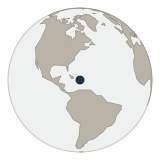
How does the Dominican Republic compare to your home country on LGBTQ+ rights, democracy and women's rights?
 LGBTQ+ rights
 Democracy & press freedom
 Women's rights
 Rule of law
 Prevention of child labour
LGBTQ+ rights
Prevention of child labour
LGBTQ+ rights
This is the Dominican Republic's weakest dimension — and, unusually, one where protection has recently gone backwards rather than simply not advancing. Same-sex activity is legal, and a November 2025 Constitutional Court ruling (TC/1225/25) struck down the old ban on gay people serving in the police and armed forces — a genuine step forward. But the wider legal frame is restrictive: the 2010 Constitution defines marriage as between a man and a woman (so there is no same-sex marriage or joint adoption), legal gender change is not possible, and there are no hate-crime protections. The penal-code reforms of 2021 and 2024–25 actually removed sexual orientation from the list of characteristics protected against discrimination — a rollback that local activists fought hard. Public attitudes are among the more conservative in the Americas. The DR is not covered by the ILGA Rainbow Europe index (Europe only), so this score comes from the Equaldex Equality Index.
Punta Cana, Puerto Plata and the other resort areas are used to international visitors, and same-sex couples holiday there without trouble inside the resort bubble. Outside it, public affection between any couple is low-key, and between same-sex couples it can draw hostility — with little legal recourse if problems arise. Santo Domingo has a small but real queer scene.
Democracy & press freedom
The Dominican Republic holds genuinely competitive elections and the EIU rates it a "flawed democracy" (6.62, 2024) — and it was the biggest improver in Latin America that year. Press freedom is comparatively healthy for the region: Reporters Without Borders ranks the DR 43rd of 180 (2025), ahead of several EU countries, with the main risks being economic pressure on newsrooms and occasional political interference rather than open repression. The persistent weak spot is corruption, which also drags on the rule-of-law score below.
Everyday travel is unaffected. Following independent Dominican journalism is the easiest way to understand the country beyond the all-inclusive gates.
Women's rights
A clearly improving headline: the DR climbed 21 places in the WEF Global Gender Gap Report 2025 (0.730, 61st), one of the year's biggest gains, with women well-represented in education and rising in politics. But that index measures the gap between women and men, not the full picture — and one thing it doesn't capture matters a lot here: the Dominican Republic has one of the world's most restrictive abortion laws, a total ban with no exceptions, even for rape, incest, or to save the woman's life. Gender-based violence and adolescent-pregnancy rates are also high. (Fair Away's women's-rights scoring is under review in 2026 precisely because the WEF index misses reproductive rights — see Sources.)
Solo women travellers generally report the DR as manageable, with the usual big-city and nightlife caution. The abortion ban is worth knowing if you could face a pregnancy-related medical emergency — legal care options are tightly constrained.
Rule of law
The Dominican Republic ranks 76th of 143 in the WJP Rule of Law Index 2025 (0.50) — mid-table, but it was the single largest global improver that year, on the back of criminal-justice reforms. Corruption and uneven enforcement remain the main drags. For ordinary tourists the system is predictable, but petty bribery still surfaces in some encounters, and property or contract disputes can be slow.
Keep copies of your passport and documents, use official taxis and registered operators, and treat informal "on-the-spot" fees from officials with caution. Travel insurance and a registered stay are sensible.
Prevention of child labour
The US Department of Labor downgraded the Dominican Republic to "Minimal Advancement" in 2024 — a step backwards. Child labour is documented in agriculture (sugarcane, coffee, rice and tomatoes) and, in some coastal areas, in commercial sexual exploitation linked to tourism. A structural driver sits underneath it: children without identity documents — disproportionately those of Haitian descent, after the 2013 Constitutional Court ruling that stripped citizenship from many — are denied schooling and social services, which pushes them toward work. This is the "political background behind the beaches" that a tourist rarely sees but that shapes real lives.
Buy food, craft and services from local adults and cooperatives rather than the cheapest street offers of unclear origin. Child sexual exploitation in tourism is a real problem on parts of the coast — if you see something that concerns you, report it (a national line and several NGOs exist).
How to travel the Dominican Republic in a way that supports your values
You've seen how the DR scores. Its beaches, music and warmth are real — and so are the concerns, especially on LGBTQ+ rights and the human-rights questions around child labour and Haitian-descended Dominicans. A lower score isn't a reason to stay home; it's a reason to travel deliberately, so your attention and money reach ordinary Dominicans rather than only the all-inclusive chains and the parts of the system the scores are really about.
↑ Back to the scoresTravelling with LGBTQ+ rights in mind
Dominican LGBTQ+ groups do their work under real legal and social pressure. TRANSSA (Trans Siempre Amigas) has campaigned for the trans community since 2006, documenting anti-trans violence and pushing for legal recognition; Diversidad Dominicana works on LGBTIQ+ legal rights and civic participation and led the fight against the penal-code exclusion (their own website is temporarily down, so we're linking their active Facebook page instead). Following and, where possible, supporting them puts your weight behind the people doing the work — far more useful than a rainbow sticker at reception.
In a climate with no anti-discrimination protection, the risk of visible affection often falls harder on your Dominican partner or hosts than on you as a foreign visitor. Taking your cue from local queer friends — rather than importing outside norms of visibility — is itself a way of keeping them safe.
Rather than a corporate booking site, start with the LGBTQ+ travel community's own listings. The IGLTA directory (the International LGBTQ+ Travel Association, since 1983) lists welcoming accommodations and operators by destination, and misterb&b lets you book stays with local hosts in Punta Cana and Santo Domingo — so your money reaches a Dominican host rather than an international chain (note it's oriented mainly to gay men). These are "welcoming" labels businesses opt into, not independent audits, so it's worth cross-checking with the groups above: TRANSSA and Diversidad Dominicana can point you to places that are genuinely part of the community.
Travelling with press freedom in mind
See the RSF World Press Freedom Index country profile (DR 43rd of 180 — relatively strong for the region). For reporting beyond the resort bubble, Diario Libre and the investigative outlet Acento are widely read independent Dominican titles; Dominican Today offers English-language coverage for visitors.
Travelling with women's rights in mind
Colectiva Mujer y Salud, founded in 1984, is one of the oldest feminist organisations in Latin America. It works on gender-based violence, women's health and sexual and reproductive rights — including the campaign against the total abortion ban. Supporting or amplifying groups like it backs the Dominican women pushing for change from the inside.
Put your money into local hands
The DR's all-inclusive model means a large share of what you pay can leave the country before it ever reaches a Dominican. Eat at local comedores and colmados, book independent Dominican guides directly, and choose locally-owned stays for part of your trip. Marketplaces like Withlocals (a B Corp) connect you with independent local hosts — the money reaches the person showing you around.
Buy craft, cigars, cocoa and coffee from local artisans and cooperatives rather than the cheapest unclear-origin goods — it keeps income with working adults, the flip side of the child-labour concerns. And treat any situation that draws a child into tourism-linked exploitation as something to report, not ignore.
Fair Away doesn't take a cut from any organisation or business listed here. These are starting points we can stand behind, not paid placements — and the list grows as travellers suggest more.
Fair Away is independent and ad-free. A one-person project built to help you travel with open eyes. If it helped you think, a double espresso keeps my thinking going.
☕ Buy me a double espressoSources & further reading
What the five scores come from
Equaldex Equality Index LGBTQ+ rights → 3.8 Equaldex Equality Index 38/100 (÷10): a Legal Index of 44 and a Public Opinion Index of 33. The same source is used for every country on Fair Away, so this score is comparable with your home country's.
EIU Democracy Index 2024 Democracy & press freedom → 6.6 6.62, "flawed democracy" (52nd); biggest improver in Latin America in 2024
Georgetown WPS Index 2025 + World Bank WBL 2026 Women’s rights → 7.2 50/50 average of lived conditions (Georgetown WPS Index 2025) and formal legal rights (World Bank Women, Business and the Law 2026, Legal Frameworks). Reproductive rights are shown as a separate sourced line, never folded into this score.
WJP Rule of Law Index 2025 Rule of law → 5.0 DR 76th of 143 (0.50); largest global improver in 2025
US ILAB, Findings on the Worst Forms of Child Labor 2024 Prevention of child labour → ~4.0 "Minimal Advancement", the third of four tiers, out of 131 countries assessed. ILAB publishes tiers rather than scores, so we map the four tiers to four evenly spaced values (8.0 / 6.0 / 4.0 / 2.0) and mark them with a ~.
Background — not part of any score
RSF World Press Freedom Index Press freedom — 43rd of 180 (2025)
See how the Dominican Republic compares to your home country across all values
Start your personalised comparison →