
How does Cyprus compare to your home country on LGBTQ+ rights, democracy and rule of law?
 LGBTQ+ rights
 Democracy & press freedom
 Women's rights
 Rule of law
 Prevention of child labour
Four of these numbers describe the south. One describes the whole island.
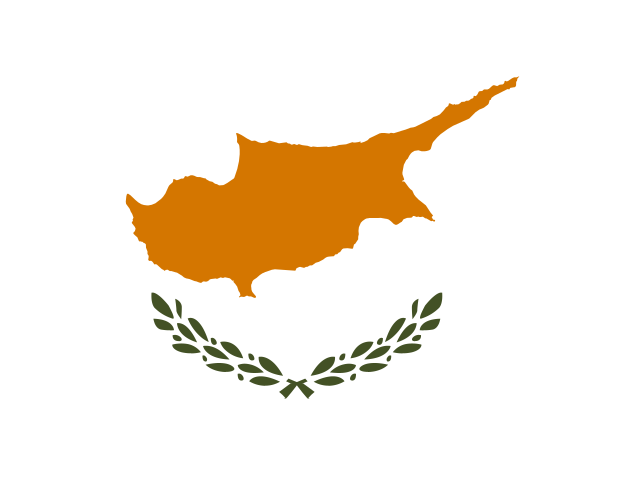
Cyprus has been divided since 1974. The Republic of Cyprus governs the southern two-thirds and joined the EU in 2004; the north is administered separately and recognised as a state only by Türkiye, and a UN buffer zone runs between them, straight through the middle of Nicosia. The EU's own position is not that the north is outside the union but that the law is suspended there: under Protocol 10 of the Accession Treaty, EU legislation does not apply in the part of Cyprus where the Republic "does not exercise effective control", which puts that area outside the EU's customs and fiscal territory and outside its area of freedom, justice and security. A separate instrument, Council Regulation 866/2004 — the Green Line Regulation — sets the terms on which people and goods cross.* You will probably cross it yourself: it is an ordinary queue with an ID check.
That division lands directly on our scorecard, and it lands unevenly. The EIU, the World Justice Project, the Georgetown WPS Index and the World Bank all score "Cyprus" meaning the Republic. Equaldex does not. It builds the island's LGBTQ+ score from district-level entries and marks several rights "varies by region" — civil unions exist in Lemesos and Pafos and are recorded as banned in Keryneia; a gender marker can be changed without restriction in Lemesos and Pafos and requires surgery in Keryneia. So the 5.1 below is an island-wide blend and the other four are southern. We have published it as read rather than dropping it, because the alternative is a page with two empty rows — but it means the LGBTQ+ number is the one figure here that is partly about a place the other four never visit.
The politics moved this year, and in the hopeful direction. On 19 October 2025 Turkish Cypriots elected Tufan Erhürman with 62.76% against the incumbent Ersin Tatar's 35.81%, on a platform of a federal settlement rather than two states — though he has said he would not pursue it without Ankara's approval.* He and President Nikos Christodoulides have been meeting through 2026, with crossing points and other confidence-building measures discussed ahead of the hard questions of property, territory and political equality.* Treat those two sentences as where things stand in October 2026 and check the date before relying on them: this is the fastest-moving thing on the page and none of the five indices will register it for another year.
LGBTQ+ rights
Cyprus scores 51 on the Equaldex Equality Index, from a Legal Index of 66 and a Public Opinion Index of 36. The specialist European audit is harsher: ILGA-Europe's Rainbow Map 2026 puts Cyprus at 33.69%, 30th of 49 countries and well under the EU average of 52.10%.*
The shape inside that figure is the useful part. Civil partnerships have been available since 2015 and same-sex conduct has been legal since 1998, so a couple is not illegal here — but marriage, joint adoption and much of the rest of recognition are absent, and the Rainbow Map scores Cyprus 19% on equality and non-discrimination and 33% on family rights. One category scores 100%: civil society space.* Read those two together and you have the country: organising is free, protection is thin.
Gender recognition shows the same pattern in miniature. The Interior Ministry told parliament in November 2025 that 51 people in Cyprus have changed the gender marker and name on their ID since 2021 — the whole caseload, over five years.* In the same month two MPs tabled an amendment that would define "woman" and "gender" in law for the first time, which human rights groups warned could push trans women out of the protections they currently have under domestic violence legislation.*
The Public Opinion score of 36 has a street-level version, and it runs in both directions in the same year. In April an "LGBT" sign was put on a traditional Easter bonfire at a church in Limassol, in the spot normally reserved for the effigy of Judas.* In May a group dressed in black broke up a pre-Pride gathering, chanting homophobic slogans and carrying double-headed eagle and Enosis flags — the iconography of union with Greece, which matters for the democracy section below.* And in September the fourth annual United by Pride sent two marches from opposite sides of the divided capital to meet in the middle for a joint celebration, which the organisers called "a beacon of hope".* Police recorded 14 anti-LGBTI incidents in 2022 and 17 in 2023.*
Limassol, Nicosia and the resort strips are unremarkable for a same-sex couple, and Pride happens on both sides of the line. The practical gap is legal rather than social: a marriage registered elsewhere is not a marriage here, which matters for hospital access and next-of-kin decisions rather than for a hotel desk. In the north, EU law does not apply at all, so anything you are relying on as an EU citizen stops at the crossing.
Democracy & press freedom
The EIU scores Cyprus 7.38, 40th of 167 and a "flawed democracy". The spread is the interesting part: electoral process 9.17 and civil liberties 8.82 against functioning of government 5.36. Cyprus is not marked down for how it votes or for what you may say. It is marked down for what the state does between elections.
That score comes from the EIU's 2024 edition, which closed before the election that changed the parliament. On 24 May 2026 ELAM took 10.9% of the vote and eight seats, moving into third place in what Euronews called a historic breakthrough.* ELAM was founded in 2008 by Christos Christou, who had "served for many years at the side of Nicos Michaloliakos", the leader of Greece's Golden Dawn; it first tried to register as "Golden Dawn, Cyprus Branch", was refused, and became a legal party in 2011. openDemocracy describes it as ultra-nationalist and far right, and notes that in its early years it was "only known for its members' violent street attacks".* None of that is in the 7.38, and an index published annually could not have put it there.
Press freedom is the half of this dimension the EIU measures only partly, and here the two sources disagree sharply. RSF puts Cyprus 80th of 180 in 2026 on 56.91, down from 77th and 59.04 in 2025 — the second-lowest in the European Union.* Its account of why is structural rather than dramatic: growing media concentration and opaque ownership, two of the four largest newspapers affiliated with political parties, owners with other business interests and direct political roles, and private media dependent on state subsidies allocated non-transparently.*
One line in that profile explains more about Cyprus than any score on this page. RSF records that the Cyprus issue is a taboo subject, and that journalists who question the official line on it are often labelled "traitors".* A country can hold free elections, keep working courts and still have one conversation it cannot have in public. That is the thing a visitor is least likely to notice and most likely to be standing in the middle of.
Nothing here reaches you at a border or a hotel. What it changes is how you read what you are told — about the division, about the north, about whose fault 1974 was. You will hear confident single-sided accounts on both sides of the line, from people who are not lying to you. If you want the fuller version, the organisations below are the ones who put both communities in the same room.
Women's rights
This is the highest score on the page, and it is an average of two halves that do not agree. Lived conditions put Cyprus 52nd of 181 on the Georgetown WPS Index; the World Bank's Legal Frameworks score is 88.35, with mobility, work, marriage, parenthood and assets each at a full 100 out of 100. The law is close to complete.
The same World Bank release publishes a second pillar asking whether anything exists to put that law into effect — budgets, agencies, complaint routes, data. Cyprus scores 58.73 there against 88.35 on the law itself, with assets at 12.5 and parenthood at 25. Its expert-opinion score for safety is 46.88, where the legal framework for safety scores 81.25. Same publisher, same edition, same spreadsheet as the 8.3 above.
What that gap looked like in practice is a matter of public record. Between 2016 and 2019 an army officer killed seven people — five women, all migrant domestic workers, and two of their daughters. The disappearances had been reported to police over several years and were not treated seriously. The justice minister resigned, the police chief was dismissed, and the president said police had acted "negligently, wrongly and unprofessionally". A Cypriot engineer, Maria Mapporidou, organised the protests that forced it into the open, and compiled a list of 32 other missing foreign women.* A legal framework scoring 88 out of 100 was in force throughout.
One right sits outside the score, as on every Fair Away page, because neither source measures it. Abortion has been legal on request up to twelve weeks since a 2018 amendment, to nineteen weeks in cases of rape, abuse or incest, and without a time limit where there is serious risk to health. Access is a separate question: the public health system covers termination only where it is medically necessary, so an elective abortion is paid out of pocket at roughly €600–800 surgically or €100–120 medically, and doctors may refuse on moral grounds.*
Cyprus is an easy country for women to travel in, including alone, and the score is not wrong about that. The gap it hides is not about tourists: it is about the women who clean the hotels. If you employ anyone through an agency here, or stay somewhere that does, that is the part of this page that touches your trip.
Rule of law
Cyprus scores 0.67 in the World Justice Project's 2025 Index, 30th of 143 countries, up 0.3% and one rank place on the year before. That is the upper third of the world and the lower half of the EU — a normal, functioning legal system with one well-documented hole in it.
The hole has a name and an inquiry. Cyprus sold citizenship to investors until 2020, when the scheme was scrapped after Al Jazeera filmed a former speaker of parliament and others apparently offering to help a fictitious applicant with a criminal record obtain a passport. A board of inquiry chaired by Myron Nicolatos, until 2020 the president of the Supreme Court, then examined 2,478 passports issued between 2007 and 2016 plus 417 high-risk cases up to 2020, and found that 51.81% of them were illegal naturalisations.* More than half of a decade of one state's naturalisations, found unlawful by its own former chief justice.
Put that beside the press-freedom finding above and you have the mechanism rather than two facts. The scheme was not stopped by a Cypriot inspectorate, a Cypriot court or a Cypriot newspaper. It was stopped by a foreign broadcaster with a hidden camera, in a country where RSF records that media owners hold other business interests and direct political roles.
Nothing here changes a holiday in the Republic: contracts, policing and consular help work as you would expect in an EU member state. North of the line is different in kind, not degree — EU law is suspended, EU consular and consumer protections do not reach you, and property titles there are the subject of the negotiation described at the top of this page. That is worth knowing before you buy anything more permanent than a meal.
Prevention of child labour
Not every country is measured on every value. Where the public data doesn't exist, we'd rather tell you than fill the gap with a guess — and Cyprus is one of those cases.
The figure on our other country pages comes from the US Department of Labor's yearly review of what governments are doing about the worst forms of child labour, and that review covers the 131 countries which hold trade preferences with the United States. Cyprus is not one of them, so it is never assessed. The obvious alternative doesn't help either: the ILO and UNICEF's global estimates are built on household surveys and leave out Europe and Northern America entirely — in their own words, "because of data limitations".
That absence is not the same as zero, and on a divided island it is less reassuring than usual: whatever is or is not happening north of the line sits outside EU labour law as well as outside this index.
Nothing you will encounter on a trip. This value reaches you as a shopper rather than as a visitor: the same US department keeps a public, searchable list of goods made with child or forced labour — clothing, cocoa, coffee, cotton, electronics, fish. Those goods end up on shelves here too. If child labour matters to you, that list is where your own spending shows up.
How to travel Cyprus in a way that supports your values
Almost nothing on this page will reach you at a hotel desk. The weight of it falls on Cypriots — and, unusually, on both sets of them. The organisations worth your attention here are the ones that work across the line rather than along it, because the pattern this page keeps finding is a conversation the country cannot have in public.
↑ Back to the scoresTravelling with LGBTQ+ rights in mind
Accept — LGBTI Cyprus is the main LGBTI organisation in the Republic: information, a route to report incidents of violence or discrimination, and the advocacy that produced a party-by-party questionnaire on LGBTQI+ rights before the May 2026 election. The site takes donations directly.
Queer Cyprus Association (Kuir Kıbrıs Derneği) has worked in the north since 2007 — legal and psychological counselling, the KuirFest film festival, and campaigning to change discriminatory law in a jurisdiction where the EU's own rules are suspended. It takes donations and memberships. Supporting only the southern organisation is the easy mistake this page exists to prevent: the Equaldex score you read above covers both of them.
Two marches, one from each side of the divided capital, meeting in the middle. It has run four times. It is also the clearest answer available to the question of what supporting a non-divided Cyprus looks like in practice — you turn up and walk.
Travelling with press freedom in mind
RSF's complaint about Cyprus is ownership: two of the four largest newspapers are affiliated with political parties, and state subsidies are handed out opaquely. The Cyprus Mail is the English-language daily and the source of two of the figures on this page, including the Rainbow Map reporting. It is a newspaper rather than an audit — read it as one — but it is the most accessible way for a visitor to follow Cypriot politics in English. RSF's Cyprus profile is where the structural picture is kept.
Travelling with women's rights in mind
The Mediterranean Institute of Gender Studies (MIGS) is a Nicosia research and advocacy organisation working on gender equality and violence against women — including PHAROS, a platform for women facing violence. The gap this page describes, between a legal framework scoring 88 and the apparatus behind it scoring 59, is the gap MIGS works in. It has a Get involved page rather than a donate button.
The women killed between 2016 and 2019 were migrant domestic workers, and the reason it took years was that nobody official treated their disappearance as urgent. That labour is still what the hospitality industry here runs on. You cannot audit a hotel from a booking page, but you can notice, tip the housekeeping staff directly and in cash, and ask a hotel how its cleaning staff are employed — whether directly or through an agency. The question is rarer than it should be, which is most of its value.
Put your money into local hands
The Home for Cooperation sits inside the UN buffer zone by the Ledra Palace crossing in Nicosia, and has done since 2011: a bicommunal community centre with a café, an open library, office space for Cypriot NGOs from both communities, and the Buffer Fringe performing arts festival. It is a ten-minute walk from either side of the old town and you can simply go in. Of everything on this page, it is the one item that is both an action and a destination.
Most of the Cypriot coast you will be offered is large-hotel and tour-operator territory, where a booking leaves the island again almost immediately. The Troodos villages, the Akamas edge and the inland wine region run on family-owned guesthouses and tavernas that take bookings directly. Agrotourism here is an established, signposted category rather than a novelty, which makes it unusually easy to choose.
Lefkara lace and Cypriot pottery are both widely imitated, with imports sold next to the real thing at exactly the places tour buses stop. Asking who made an object and where is a normal question here and is usually answered at length. The answer decides whether your money stays in the village you are standing in.
Fair Away doesn't take a cut from any organisation or business listed here. These are starting points we can stand behind, not paid placements — and the list grows as travellers suggest more.
Fair Away is independent and ad-free. A one-person project built to help you travel with open eyes. If it helped you think, a double espresso keeps my thinking going.
☕ Buy me a double espressoSources & further reading
What the five scores come from
Equaldex Equality Index LGBTQ+ rights → 5.1 Equaldex Equality Index 51/100 (÷10): a Legal Index of 66 and a Public Opinion Index of 36, 62nd of all regions. One source is used for every country on Fair Away, so this score is comparable with your home country's — with the Cyprus-specific caveat that Equaldex scores the island by district and so blends the Republic with the north, while the four sources below cover the Republic only
EIU Democracy Index 2024 Democracy & press freedom → 7.4 7.38, 40th of 167, "flawed democracy", down three rank places. Electoral process 9.17 and civil liberties 8.82 against functioning of government 5.36 and political culture 6.88. This edition closed before the parliamentary election of 24 May 2026
Georgetown WPS Index 2025 + World Bank WBL 2026 Women’s rights → 8.3 50/50 average of lived conditions (WPS 0.770, 52nd of 181 → 7.70) and legal frameworks (WBL Legal Frameworks 88.35 → 8.835). Five of the ten WBL legal topics score 100, against childcare 66.75 and entrepreneurship 50; the same release scores Cyprus 58.73 on Supportive Frameworks and 46.88 on expert-opinion safety
WJP Rule of Law Index 2025 Rule of law → 6.7 Cyprus 0.67, 30th of 143, up 0.3% and one rank place on 2024. Direct reading, no proxy
US ILAB Findings on the Worst Forms of Child Labor Prevention of child labour → No data ILAB assesses the 131 countries that hold trade preferences with the United States and does not assess Cyprus, so there is no tier to convert. The ILO/UNICEF global estimates exclude Europe and Northern America
Background — not part of any score
European Commission — the Green Line Regulation Why the division changes what EU membership means here: under Protocol 10 the acquis is suspended in the area the Republic does not effectively control, putting it outside the EU's customs and fiscal territory, and Council Regulation 866/2004 governs the crossing of people and goods
ILGA-Europe — Annual Review 2026, Cyprus The year in detail: 51 gender marker changes since 2021, the November 2025 draft amendment defining "woman" and "gender", recorded anti-LGBTI incidents, the Limassol Easter bonfire, the disrupted pre-Pride gathering, and United by Pride meeting in the middle of Nicosia
Cyprus Mail — Cyprus 30th in Europe on LGBTI rights The Rainbow Map 2026 in local reporting: 33.69% against an EU average of 52.10%, equality and non-discrimination at 19%, family rights 33%, civil society space 100%
RSF World Press Freedom Index 2026 — Cyprus 80th of 180 with 56.91, down from 77th and 59.04 in 2025, the second-lowest in the EU. Media concentration, party-affiliated newspapers, opaque state subsidies — and the Cyprus issue recorded as a taboo subject on which questioning journalists are labelled "traitors"
Euronews — the parliamentary election of 24 May 2026 The result the EIU edition could not include: ELAM third with 10.9% and eight seats
openDemocracy — the remnants of Golden Dawn in Cyprus Miranda Christou on ELAM's origins: founded in 2008 by a long-time associate of Golden Dawn's leader, refused registration as "Golden Dawn, Cyprus Branch", a legal party from 2011. Full text behind a subscription wall; the facts cited here are in the opening
InfoMigrants — how one woman forced Cyprus to confront the killings Seven victims, the years of unanswered missing-person reports, the resignation of the justice minister and dismissal of the police chief, and the list of 32 other missing foreign women
Politis — legal but not equal: abortion access in Cyprus Legal to twelve weeks since 2018, and the public-insurance exclusion, out-of-pocket costs and conscientious objection that sit between the law and the procedure
Al Jazeera — most Cyprus passports issued in the investment scheme were illegal The Nicolatos inquiry: 2,895 naturalisations examined, 51.81% found unlawful, and the undercover filming that ended the scheme in 2020
See how Cyprus compares to your home country across all values
Start your personalised comparison →