

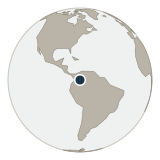
How does Colombia compare to your home country on LGBTQ+ rights, democracy and rule of law?
 LGBTQ+ rights
 Democracy & press freedom
 Women's rights
 Rule of law
 Prevention of child labour
One of these numbers is older than the government it describes
Colombia changed president five weeks before this page was written. Abelardo de la Espriella won the run-off on 21 June 2026 by 49.66% to 48.70% — the narrowest margin in the country's history — and was sworn in on 7 August in Cali rather than Bogotá, promising to abandon the negotiated-peace approach of the outgoing government and to "relentlessly defeat narco-terrorism".*
Our democracy score comes from the EIU's 2024 edition, which measures the years before that. We publish it anyway, because every number on this site has to trace to a published source and inventing a fresher one would be worse. But you should read it knowing what it does not cover.
The three sources that do reach into 2026 disagree with each other, which is itself worth knowing rather than smoothing over. The World Justice Project records Colombia among the countries where freedom of expression, freedom of assembly and civic participation all declined in 2025.* Reporters Without Borders has Colombia at 102nd of 180 in 2026 and lists it among the countries that recorded improvements.* And Colombia's own press-freedom foundation wrote to the new president a month into his term, saying the first weeks had not matched his public commitment.* Three credible readings, three different pictures, and none of them measuring the government now in office.
LGBTQ+ rights
Colombia scores 71 on the Equaldex Equality Index, fifth of the twelve countries measured in South America. Split it and you get the most useful fact about the country on this value: a Legal Index of 92 against a Public Opinion Index of 50. Equaldex publishes that 42-point gap as a finding in its own right — Colombia is the third-largest case in the region of law running ahead of public attitudes, behind Bolivia and Ecuador.*
The legal side is close to complete, and most of it was won in court rather than in Congress. Same-sex marriage has been legal since 2016 and joint adoption since 2015. Non-binary gender has been legally recognised since 2022. Employment and housing discrimination are prohibited on both sexual orientation and gender identity, and Colombia is one of the few countries anywhere with a full ban on medically unnecessary surgery on intersex infants.*
Two gaps in that framework matter more than their size suggests. Hate crime protections cover sexual orientation but not gender identity, and conversion therapy is not banned.* The first of those is the one to hold onto, because the group least protected by the statute book is also the group facing the most violence. Caribe Afirmativo, which has documented this from the Caribbean coast since 2009, publishes an annual count of killings, threats, digital violence and discrimination by the state against LGBTIQ+ people. Its 2025 edition is titled A system that fails, and impunity is the argument: threats, it says, do not only precede violence but produce it. One figure from that report is worth carrying: between 2021 and 2025, one in six killings of LGBTIQ+ people in Colombia happened in Antioquia — the department Medellín is in.*
For most LGBTQ+ visitors Colombia is straightforward and often very good. Bogotá's Chapinero is one of the larger queer districts in South America; Medellín and Cartagena both have established scenes. The thing to carry with you is the shape of the gap: the law will almost certainly be on your side, and the street is a separate question that varies enormously between a Bogotá neighbourhood and a small town two hours away. Trans and gender-non-conforming travellers should know that the protection thinning out is specifically theirs — the legal recognition is strong, the hate crime statute does not name them.
Democracy & press freedom
The EIU puts Colombia at 6.35 for 2024 — 60th of 167, a "flawed democracy", down five rank places. The internal spread is one of the widest on this site. Electoral process scores 9.17 and civil liberties 7.65; political culture scores 3.13 and functioning of government 5.71. Colombia runs elections that work and hands power over when it loses them, on top of a political culture the index rates among the weakest in the region.
The 2026 transition is a live demonstration of both halves. The outgoing president initially refused to accept the result and alleged manipulated tallies; international observers and the electoral authorities dismissed the claim, and the handover happened on schedule.*
Press freedom is where to watch next, and Colombia has an unusually good instrument for watching it. The Foundation for Press Freedom (FLIP) has tracked attacks on journalists since 1996 and publishes a live map of them by department. In September 2026 it analysed the new government's Presidential Directive 01, which sets out how officials may deal with the media, and flagged limits on contact between public servants and journalists as the part worth watching.* Reporters Without Borders, measuring the year before, ranks Colombia 102nd of 180 and counts it among the region's improvers.*
An ordinary trip carries on unaffected by any of this, and Colombian political conversation is loud, open and easy to join. Two practical notes. Colombian journalism in Spanish is excellent and worth reading while you are there rather than after. And the risk to reporters is concentrated in the regions rather than the capital — the departments where armed groups operate are where the threats are counted, which is the same map as the security advice further down this page.
Women's rights
Our two sources are 2.6 points apart here, the widest gap on this page, and the reason is not gender law. The World Bank's legal frameworks score is 81.05, with full marks on mobility, marriage, parenthood, childcare and property. The Georgetown WPS Index, which measures lived conditions, puts Colombia at 0.551 — 149th of 177. Inside that index, absence of legal discrimination scores 84.4. What drags it down is proximity to conflict at 93.2% and community safety at 42%: fewer than half of Colombian women say they feel safe walking alone at night where they live.
Reproductive rights run the other way from most of the countries on this site, and they are worth stating plainly because the headline score hides them. On 21 February 2022 the Constitutional Court decriminalised abortion up to 24 weeks in a 5–4 ruling, making Colombia the first country in Latin America and the Caribbean to legalise it that far into a pregnancy; after 24 weeks the existing grounds — rape or incest, fetal non-viability, and risk to health including mental health — continue to apply.* Neither of our two sources measures this, which is why it is a separate line rather than part of the number.
Women travel independently across Colombia in large numbers and the practical experience in the cities and on the coffee and Caribbean routes is usually good. The specific caution is about where rather than whether: the WPS ranking is driven by regions where armed groups operate, not by Bogotá, Medellín or Cartagena. Standard care applies in nightlife districts, and drink spiking with scopolamine is a documented and locally well-known risk in Bogotá and Medellín — watch your own drink, and be wary of dating-app meetings in private homes.
Rule of law
This is the lowest of the five and the factor breakdown is more useful than the total. The World Justice Project puts Colombia at 0.47 for 2025 — 95th of 143, down 1.8%. Within that: open government ranks 37th of 143, and second of the 41 upper-middle-income countries. Order and security ranks 134th of 143, and 41st of 41 — last in its income group. Criminal justice is 120th and absence of corruption 100th.*
A country that is unusually transparent about itself and close to the bottom of the world on physical security is a strange combination, and it is the single most accurate summary of what Colombia is like to be in. The state publishes, discloses and permits; it does not reliably control territory. The decline is documented rather than inferred: WJP names Colombia among the countries where freedom of opinion and expression, freedom of assembly and association, civic participation, judicial independence and civil justice all fell in 2025.*
This is the score that should actually change how you plan. Colombia's tourist routes — Bogotá, Medellín, the coffee region, Cartagena, Santa Marta, Tayrona — are travelled by large numbers of people without incident, and the country is not the one from the 1990s. But the security picture is regional and it moves: parts of Cauca, Catatumbo, Arauca, Chocó and the Venezuelan border are a different country from the tourist circuit, and that is where the low ranking lives. Check current regional advice close to departure rather than relying on a guidebook, take registered taxis or apps rather than street cabs at night, and treat the standard local advice — no dar papaya, don't hand anyone an opportunity — as the practical version of a 134th place on order and security.
Prevention of child labour
This is Colombia's strongest value and one of the strongest scores in the region. The US Department of Labor assessed Colombia as making Significant Advancement in 2024 — the top of its four tiers, awarded to nine countries out of the 131 assessed, and Colombia's twelfth.* The number is our approximation of that tier rather than a published score, which is why it carries a tilde. Twelve consecutive top assessments is a real institutional record, and it is the clearest case on this page of a Colombian state doing something well and consistently.
It is also worth being clear about why that effort is needed, because the two facts belong together. The department records recruitment of children by non-state armed groups as a categorical worst form of child labour in Colombia, and commercial sexual exploitation alongside it. The tier measures what the government does about the problem; it does not measure the size of the problem.
One part of this connects directly to travel, and it is specific enough to act on. Colombia has written the tourism industry into its child-protection law: Law 679 of 2001, strengthened by Law 1336 of 2009, places explicit obligations on hotels, tour operators and transport companies to prevent the sexual exploitation of children.* That means a hotel or operator in Cartagena is not making a voluntary gesture when it displays a child-protection code; it is meeting a legal duty, and you can ask about it.
Cartagena is both the country's main tourist city and the place where child sexual exploitation in travel has been documented longest, which is precisely why the prevention work is based there. Two concrete things: look for whether your hotel or tour operator has signed a child-protection code and ask if it is not displayed, and report anything that looks wrong rather than assuming somebody else has. The national child welfare institute (ICBF) takes reports on 141, and Fundación Renacer runs the prevention programme in the city.
The armed conflict is not one of our five values, and it moves three of them
Colombia signed a peace accord with the FARC a decade ago, and a large part of it held: the movement demobilised, and the country's politics changed as a result. What did not end was the conflict itself. Dissident factions that rejected the accord, the ELN and the Clan del Golfo remain active, and the southwest around Cali is contested territory.*
None of our five indices has a column for that, and yet it is doing most of the work in three of them. It is why the WPS Index puts Colombia 149th on lived conditions for women while the World Bank scores its gender laws at 81 out of 100. It is why order and security ranks last in Colombia's income group while open government ranks second. And it is behind the worst form of child labour the US Department of Labor records here.
We flag this rather than score it, for the same reason we do elsewhere: there is no published index that measures conflict exposure on one comparable ruler across every country on this site, and inventing one would be worse than naming the gap. For a visitor the practical consequence is simple — the difference between regions in Colombia is larger than the difference between many countries on this site, and a national score cannot show you that.
How to travel Colombia in a way that supports your values
You've seen how Colombia scores. The pattern is unusual and it shapes what is worth doing: the law and the institutions are often ahead of the country's daily reality, not behind it. Marriage equality, a 24-week abortion right, twelve top child-labour assessments, second in its income group on open government — these are real. What is missing is reach: enforcement, security, and protection that holds in a small town as well as in a capital. That makes the organisations below unusually worth supporting, because they work in exactly that gap.
↑ Back to the scoresTravelling with LGBTQ+ rights in mind
Colombia Diversa has worked since 2004 on the litigation and research behind most of the rights in the score above, and publishes in English. Caribe Afirmativo is the one to know if you are going to the coast: based in Barranquilla since 2009, working across Cartagena and the Caribbean region, it documents violence and impunity against LGBTIQ+ people and runs the access-to-justice programme for lesbian, bisexual and trans women. Both take donations directly.
The IGLTA directory (International LGBTQ+ Travel Association, non-commercial, running since 1983) and misterb&b both list welcoming stays in Bogotá's Chapinero and in Medellín; booking with a local host keeps the money in Colombian hands rather than routing it to an international chain. Be clear-eyed about it: these are opt-in commitments rather than independent audits, and misterb&b's listings skew heavily towards gay men. Colombia's legal protections are strong enough that a platform badge adds less here than it does elsewhere — the local organisations above are the better guide to which places are actually safe.
Travelling with press freedom in mind
The Foundation for Press Freedom (FLIP) has defended Colombian journalists since 1996. It runs a case-support service for reporters under threat, publishes a public map of attacks by department, and is currently the clearest voice on how the new government relates to the press — it has an English section. The RSF country profile (102nd of 180 in 2026) is the shortest outside briefing. Reading Colombian reporting while you are in Colombia is a small thing that changes what you see.
Travelling with women's rights in mind
The women's score is held down by conflict and everyday safety rather than by law, and that is precisely the terrain Corporación Sisma Mujer has worked since 1998: legal and psychosocial support for women survivors of violence, litigation on sexual violence committed during the armed conflict, and support for women human rights defenders in the regions where the threats are. It takes donations directly.
Travelling with child protection in mind
Colombian law requires tourism businesses to take specific measures against the sexual exploitation of children, so asking about it is a normal question rather than an awkward one. Fundación Renacer — ECPAT's member organisation in Colombia since 1998, with care centres in Cartagena and Riohacha — is who built that prevention work, including the long-running La Muralla ¡Soy Yo! campaign with Cartagena's tourism sector and the child-protection certification for hotels and operators. If you are booking in Cartagena, choosing a business that has signed up is the single most direct thing on this page.
Put your money into local hands
Coffee is the thing most visitors take home, and the gap between what a tourist pays and what a grower receives is the whole issue. Buying at origin — the farm visits and cooperative shops of Quindío, Risaralda and Caldas, or a roaster in Bogotá or Medellín that names its producers — puts a much larger share in the hands of the people who grew it than an airport tin does. Asking which farm it came from is a normal question in Colombia and usually answered with enthusiasm.
Choose independent operators and local guides over large packaged tours. Withlocals (a B Corp) connects you directly with independent hosts in Cartagena, Bogotá and Medellín and pays the host directly — so you know where the money lands. In Medellín in particular, a guided walk in Comuna 13 booked through a community-based operator and one booked through a hotel desk are very different transactions for the neighbourhood.
Fair Away doesn't take a cut from any organisation or business listed here. These are starting points we can stand behind, not paid placements — and the list grows as travellers suggest more.
Fair Away is independent and ad-free. A one-person project built to help you travel with open eyes. If it helped you think, a double espresso keeps my thinking going.
☕ Buy me a double espressoSources & further reading
What the five scores come from
Equaldex Equality Index LGBTQ+ rights → 7.1 Equaldex Equality Index 71/100 (÷10): a Legal Index of 92 and a Public Opinion Index of 50, 5th of the 12 countries measured in South America. Equaldex's own regional table lists Colombia as the third-largest case of legal progress running ahead of public opinion, at −42. One source is used for every country on Fair Away, so this score is comparable with your home country's.
EIU Democracy Index 2024 Democracy & press freedom → 6.4 6.35, 60th of 167, "flawed democracy", down five rank places. Electoral process 9.17 and civil liberties 7.65 against political culture 3.13 and functioning of government 5.71. This edition closed before the June 2026 election and the change of government in August 2026
Georgetown WPS Index 2025 + World Bank WBL 2026 Women’s rights → 6.8 50/50 average of lived conditions (WPS 0.551, 149th of 177 → 5.5) and legal frameworks (WBL Legal Frameworks 81.05 → 8.1). Inside the WPS half, absence of legal discrimination scores 84.4 while proximity to conflict is 93.2% and community safety 42%
WJP Rule of Law Index 2025 Rule of law → 4.7 Colombia 0.47, 95th of 143, down 1.8% and three rank places, 22nd of 32 in Latin America & the Caribbean. Open government 37th of 143 (2nd of 41 upper-middle-income countries) against order and security 134th of 143 (41st of 41), criminal justice 120th and absence of corruption 100th
US ILAB 2024 Findings on the Worst Forms of Child Labor Prevention of child labour → ~8.0 "Significant Advancement", the top of four tiers, approximated to 8.0 and marked with a ~ because ILAB publishes tiers rather than scores. One of nine countries out of 131 assessed, and Colombia's twelfth such assessment. ILAB records recruitment of children by non-state armed groups and commercial sexual exploitation as categorical worst forms
Background — not part of any score
RSF World Press Freedom Index 2026 — Americas Press freedom — Colombia 102nd of 180, listed among the countries in the region that recorded improvements, in a region that has fallen 14 points since 2022
Fundación para la Libertad de Prensa (FLIP) Press freedom — Colombia's own press-freedom foundation, active since 1996; publishes a live map of attacks on journalists by department, and its September 2026 analysis of Presidential Directive 01 on government–media relations
Caribe Afirmativo — annual report 2025 LGBTQ+ rights — Un sistema que falla, the annual documentation of homicides, threats, police violence and discrimination against LGBTIQ+ people in Colombia. This is the lived-experience counterweight to a Legal Index of 92
Center for Reproductive Rights — Causa Justa Women's rights — the Constitutional Court ruling of 21 February 2022 decriminalising abortion up to 24 weeks — the first in Latin America and the Caribbean to go that far. Neither of the two sources behind the women's score measures reproductive autonomy
Al Jazeera — the August 2026 change of government Democracy — Abelardo de la Espriella sworn in 7 August 2026 after a run-off win of 49.66% to 48.70%; the end of the negotiated-peace approach, and the armed groups still active in the southwest. No index has measured this government yet
See how Colombia compares to your home country across all values
Start your personalised comparison →