

How does Cambodia compare to your home country on LGBTQ+ rights, democracy and the rule of law?
 LGBTQ+ rights
 Democracy & press freedom
 Women's rights
 Rule of law
 Prevention of child labour
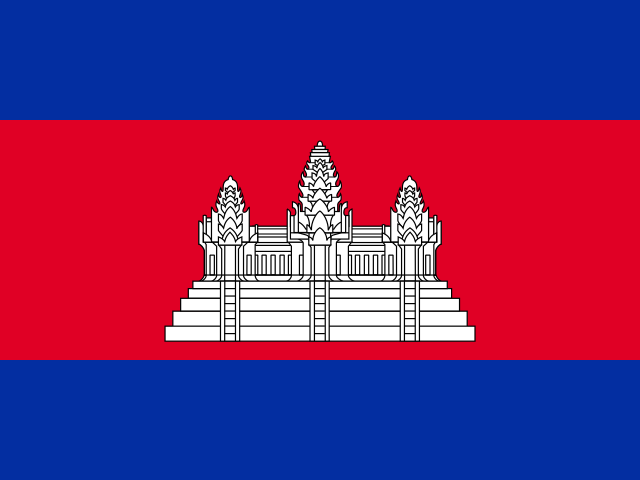
The photograph at the top of this page is part of the story
Angkor is why most people come. It is extraordinary, the guiding is good, and Cambodian hospitality is genuine. This page takes all of that as read.
It also has to say what happened around the temples. From the second half of 2022 the authorities began moving a reported 10,000 families out of the Angkor park at Siem Reap, saying the site had to be protected so that it would keep its UNESCO World Heritage status. Amnesty International interviewed more than a hundred of those people and visited the park and two relocation sites nine times. It concluded that the moves were forced evictions in breach of international law: families were warned of power cuts, flooding and arrest, told that anyone who protested would go to prison, and moved to a site 45 minutes from town that had no houses, no adequate water and no way to earn a living.*
In at least fifteen cases the families were told that UNESCO was the reason they had to leave. UNESCO's own World Heritage Centre told Amnesty that it has never called for population displacements and that a state's actions are not its responsibility "even if a Member State were to justify its actions by invoking the Organization."*
None of the five indices below measures this. We are putting it above them rather than below, because it is the one thing on this page that is directly about the place you are going to stand.
LGBTQ+ rights
Equaldex scores Cambodia 48/100 — a Legal Index of 45 and a Public Opinion Index of 51 — placing it 75th of the countries it measures.* That puts Cambodia above Singapore, Malaysia, Indonesia and Sri Lanka on this dimension, and roughly level with South Korea — all of them richer, and three of them considerably more democratic. It is worth pausing on that before reading on, because it breaks the pattern most people expect.
The reason is a floor that was never removed. Same-sex conduct has never been a crime in modern Cambodia, and there is no law restricting the discussion of LGBTQ+ topics.* What is missing is everything built on top of that floor: national law defines marriage as between a man and a woman, there are no anti-discrimination protections in employment or housing, no hate-crime protections, no legal route to change your gender, and no ban on conversion practices. Gender-affirming care is legal but scarce and expensive.
The second half of the score is the more surprising one. The public sits ahead of the law here, which reverses the usual order on this site. Pew found in 2023 that 57% of Cambodians favour allowing same-sex couples to marry, against a 24-country study average of 53.7%; Gallup's 2024 round placed Cambodia 37th of 121 on whether people consider their own area a good place for gay and lesbian people, at 53% against a study average of 40.3%.* Some of that predates any campaign: the late King Sihanouk publicly supported same-sex marriage in 2004. And something is moving underneath the law without changing it — 68 of Cambodia's 1,652 communes now issue a "declaration of family relationship", a local document giving same-sex couples limited recognition that national law does not provide.*
One thing to hold alongside that. Equaldex records concerns that the Village Commune Safety Policy has been used to arrest LGBTIQ+ Cambodians on the assumption that they are gang members or sex workers — a reminder that in a country with a weak legal system, the absence of a criminal ban is not the same as protection from the police.*
Cambodia is one of the more relaxed countries in the region for LGBTQ+ visitors. Phnom Penh and Siem Reap both have open venues, same-sex couples generally travel without difficulty, and there is no law you can fall foul of by being together. Public affection is read the same way for everyone here — Cambodians are restrained about it in public regardless of who they are with, so matching that is about local custom rather than about safety. The gap to be aware of is legal rather than social: if something goes wrong, a same-sex partner has no recognised standing in a hospital or a police station.
Democracy & press freedom
The EIU put Cambodia at 2.94 in its 2024 edition — 123rd of 167, in the "authoritarian regime" band, down two rank places. The component scores are where the number becomes concrete: electoral process and pluralism scores 0.00, the lowest value the index can give, and civil liberties 2.35.* Cambodia has been governed by one party for four decades; Hun Sen handed the office of prime minister to his son Hun Manet in August 2023.
Press freedom is where the picture is most contested, and it is worth setting out both halves. Reporters Without Borders describes a media sector that thrived until 2017, when Hun Sen began what it calls a ruthless war on journalistic freedom, and says the pattern has continued under his son. The independent outlet Voice of Democracy was closed in February 2023; the site that grew out of it, Kamnotra, was blocked, as were Radio Free Asia and the Cambodia Daily. RSF describes the Cambodian Journalists Alliance, CamboJA, as "the only organization left providing independent news." Four journalists are currently detained. In December 2024 Chhoeung Chheng, who covered environmental issues, was shot dead by a suspected illegal logger in Siem Reap province.*
And yet the RSF number moved upward. Its 2026 Index places Cambodia 151st of 180 on a score of 33.28, up ten places and 5.10 points on 2025, when it stood 161st on 28.18 — one of the larger year-on-year improvements anywhere.* Two credible sources therefore point in opposite directions, which is why there is no trend arrow on this dimension. A rise from an extremely low base, in a year in which a journalist was held for six months over reporting on the 2025 border conflict with Thailand and another was detained after reporting on a scam compound, is a real movement in a measurement and not yet a change you could describe as an opening.*
Ordinary travel carries on untouched by this, and Cambodians speak freely in private. What carries consequences is publishing: prosecutions have followed social-media posts, and a Cambodian who shares or is named in your post carries a risk that you do not. Avoid photographing police, soldiers and government buildings. Border areas with Thailand have seen armed clashes since 2025 and crossings there have been disrupted — check the current position before planning an overland route rather than assuming a border post is open.
Women's rights
The 6.5 is a 50/50 blend of lived conditions (Georgetown WPS Index 0.667, 104th of 177) and formal legal rights (World Bank WBL 2026 Legal Frameworks, 62.73). It is the highest of Cambodia's five scores, and it is the one to read most carefully, because it places Cambodia above Egypt, Tunisia, India, Sri Lanka, Jordan and Kenya — which is not what the detail underneath supports.
Inside the legal half the spread is extreme. Mobility scores 100, Assets 100 and Pension 91.75, while Safety scores 25 and Childcare scores 0.* A composite that averages a perfect score and a zero produces a middling number describing neither. The Safety 25 is the measure of legal protection against violence, and it is the figure that matters most to the people the index is about.
The other half needs the same care. The WPS Index rewards, among other things, women's participation in paid work, and Cambodia's is high — largely because of the garment industry, which employs hundreds of thousands of women and is also where the country's documented labour problems sit. A number that goes up partly because women are in a sector with poor conditions is measuring something real, but not the thing a reader assumes.
Cambodia is generally straightforward for women travelling alone, including on the Angkor circuit and in Phnom Penh, with the usual urban precautions and more care after dark in nightlife areas. Dress is relaxed by regional standards, with temples the exception — shoulders and knees covered is required at Angkor and enforced at the entrance. Reproductive rights sit outside this score, as on every Fair Away page: the 1997 Abortion Law permits termination on request up to twelve weeks, and beyond that on grounds including risk to the woman's life, foetal impairment, rape and incest — which is more permissive than the law in several countries scoring higher on this dimension.*
Rule of law
The World Justice Project puts Cambodia at 0.31 in 2025 — 141st of 143 countries, 15th of 15 in East Asia and the Pacific, and 35th of 35 among lower-middle-income countries. Only Venezuela and Afghanistan score lower anywhere in the world.* This is a direct reading of the house index, not a proxy, so there is no tilde on it. It is the lowest rule-of-law score on Fair Away.
The factor breakdown is the part a traveller should read. Of WJP's eight factors, Cambodia ranks 142nd on Absence of Corruption, 142nd on Open Government, 142nd on Civil Justice, 141st on Regulatory Enforcement and 140th on Constraints on Government Powers — and 100th on Order and Security.* That single gap explains a great deal. The streets are orderly, the temples are policed, a visitor's week passes without incident — and none of that is the same as a working legal system. Cambodia is not a dangerous country to be in. It is a country where the people who live there have no reliable remedy.
One detail sits against the trend, and it is worth reporting. In an Index year in which 68% of countries declined, WJP records that "freedom of opinion and expression", "freedom of assembly and association" and "civic participation" each fell in over 70% of countries but not in Cambodia, and that civil justice weakened in 68% of countries but not here either.* Read honestly, that is a floor rather than a recovery: these things did not fall further because there was little left to lose. Judicial independence, meanwhile, declined here along with most of the world.
Everyday risk to a visitor is low and tourist areas are actively policed. Two things carry consequences well beyond what a European traveller expects. Drug offences are prosecuted severely, and so are offences involving antiquities — removing or buying carved stone or temple artefacts is trafficking in cultural property, not a souvenir purchase. Petty corruption at checkpoints and border posts is common; asking for an official receipt is a better response than arguing. Because civil justice ranks 142nd of 143, assume that a dispute over a booking, a rental or an accident will not be resolved through a court, and insure accordingly — motorbike accidents are the single most common way visitors find this out.
Prevention of child labour
The US Department of Labor places Cambodia in the Minimal Advancement tier for 2024 — the third of four, one of 46 countries in that band — and adds the qualifier that carries the weight: "Efforts Made but Continued Practice that Delayed Advancement."* Cambodia is one of 23 countries flagged that way. The practice in question is the failure to investigate and prosecute officials involved in the worst forms of child labour, including commercial sexual exploitation and debt-bonded labour in brick kilns. ILAB publishes a tier rather than a score, so the 4.0 is our approximation of that tier — which is what the tilde on the bar means.
The same report credits Cambodia three times, and both halves belong here. In 2024 the government launched an anonymous complaint box allowing the public to report child-labour violations, increased its number of labour inspectors from 572 to 631, and enacted or launched a new policy or action plan — ILAB cites Cambodia as one of its examples of countries strengthening their labour inspectorates that year.* It also says Cambodia needs to improve coordination between ministries. This is not a country doing nothing; it is a country doing things while leaving the officials involved untouched.
The brick kilns are the clearest documented case. The Cambodian League for the Promotion and Defense of Human Rights documented 21 brick factories across Kandal province and Phnom Penh, and found that debt bondage remains widespread and that low per-brick payments still drive children as young as nine to work in the factories. Its operations director calls the workers' debts to factory owners "textbook examples of criminal debt bondage." The report also found the pre-consumer waste of 19 international garment brands being burnt as cheap kiln fuel across seven of those factories, with workers and their children reporting respiratory problems and headaches; of the brands LICADHO contacted, five replied within the requested time.*
Two things touch visitors directly. Orphanage visits and short volunteer placements with children are the first: 77% of children in Cambodian residential care have a living parent, and unvetted volunteering raises the risk of grooming — the Cambodian organisation working on this campaigns against orphanage visits rather than trying to improve them.* The second is begging and vending by children around temple sites and nightlife streets; giving money reliably keeps a child there rather than in school, and local child-protection organisations ask visitors not to. If you see a situation involving a child that worries you, there is a hotline that takes reports from foreigners — it is in the action block below.
The industry none of these numbers measure
Since 2022 Cambodia has become the centre of a global online-fraud industry run out of guarded compounds, staffed in large part by people who were trafficked into them. In June 2025 Amnesty International documented more than fifty such compounds as sites of slavery, human trafficking, forced labour and torture, operating as prison-like facilities under organised criminal groups.*
In July 2025 the government launched its largest crackdown, arrested several gang leaders and said it had closed more than 200 scam centres. Amnesty returned in June 2026 with a 150-page follow-up. It identified 33 further compounds — 86 in total — and found evidence of state intervention at only 24 of them. It interviewed 73 survivors from 16 countries, and concluded that not one of them had been recognised as a victim of trafficking, although in its assessment all of them met the international definition. Survivors described police removing bodies from a compound in Prey Veng without making an arrest, and managers being warned of raids in time to move people elsewhere.*
This does not put a visitor at risk, and it is not a reason to avoid the country. It is here for two reasons. It is the single largest human-rights story about Cambodia in the world right now, and none of our five dimensions can see it — the industry is run by criminal networks that the state has not dismantled, which is a different thing from a law we could score. And it is the clearest illustration of what a rule-of-law score of 0.31 means in practice: the people held in those compounds were inside a country with police, courts and a government, and none of it reached them.
We flag this rather than score it. Recruitment is done through fake job advertisements on Facebook and Instagram, aimed at people looking for work abroad rather than at tourists — so if the useful thing you take from this section is anything, let it be that.
How to travel Cambodia in a way that supports your values
Cambodian civil society is under real pressure and still working in the open — an LGBT organisation registered with the Ministry of Interior and active in all 25 provinces, a journalist-run news alliance, a child-protection body that trains hotels and tour operators, a legal-aid group that has documented the brick kilns for years. Tourism is one of the country's largest sources of foreign currency, and Angkor's ticket revenue goes to a state enterprise, so where the rest of your money lands is a real question rather than a rhetorical one.
↑ Back to the scoresTravelling with LGBTQ+ rights in mind
Rainbow Community Kampuchea (RoCK) has worked on LGBT rights since 2009 and in 2014 became the first LGBT organisation registered with the Ministry of Interior. It organises in all 25 provinces and cities, and the commune-level "declaration of family relationship" described above is the kind of thing that campaigning produces. Its advocacy work is the route to marriage equality in a country where the public is already ahead of the statute book.
The IGLTA member directory lists LGBTQ+-welcoming accommodation worldwide and is a membership body rather than a booking engine, so it does not take a cut of your stay. Treat it as a starting point rather than an audit: these are self-declared commitments, not inspections. In Cambodia the practical question is less about being refused a room — that is uncommon — and more about choosing a locally owned place over an international chain.
Travelling with press freedom and rule of law in mind
CamboJA News is published by the Cambodian Journalists Alliance, founded in 2019, and RSF describes it as the only organisation left providing independent news in the country. It also trains journalists and provides legal support to those facing charges. Reading it for a week before you travel gives you a picture that neither the guidebook nor the international wires will.
LICADHO — the Cambodian League for the Promotion and Defense of Human Rights — has been investigating the brick factories since at least 2016, and its reports are the primary source behind most of what is known about debt bondage and child labour in that industry. It also runs two public trackers worth knowing about: Prisoners of Interest, a list of politicians, activists and unionists arrested over peaceful activism, and Court Watch, which follows the cases against them.
RSF's Cambodia profile carries the current score, the detention figures and the case-by-case releases. It is the source for both halves of the contested picture on this page — the ten-place rise and the four journalists in custody — and reading it whole is more useful than either number alone.
Travelling with women's rights in mind
The Cambodian Women's Crisis Center has run crisis intervention, legal services and safe shelters since 1997, with offices in Phnom Penh, Banteay Meanchey, Kampong Thom and Siem Reap — the last of which covers the district most visitors pass through. It also works on safe migration and trafficking prevention in the border province of Banteay Meanchey, which is the recruitment ground for a lot of what goes wrong later. It takes donations directly.
The women's-rights figure on this page is lifted partly by how many Cambodian women are in paid work, and most of that is garment manufacturing. The industry reaches further than the factory floor: LICADHO found the offcut waste of nineteen international brands being burnt as fuel in brick kilns worked by bonded families. Buying clothing from a workshop or cooperative that will tell you who made it puts your money in a different place than a stall selling factory overruns. It is a small thing, and it is aimed at the right question.
Travelling with children's rights in mind
This is the clearest single choice a visitor to Cambodia makes. APLE Cambodia, a child-protection organisation founded in 2003, campaigns against orphanage visits and trains tour operators and hotels on screening and codes of conduct, because 77% of children in residential care have a living parent and unvetted volunteering increases the risk of grooming. A well-meant afternoon at an orphanage is part of the reason the sector exists.
APLE runs a hotline and an INHOPE-linked internet hotline, and takes reports from members of the public, including foreign visitors. If something involving a child concerns you — in a guesthouse, on a beach, around a temple — that is where it goes. Reporting it to a hotel manager is not the same thing.
Children selling postcards and bracelets at Angkor and on Pub Street are working, and buying from them makes the work pay. Every Cambodian child-protection organisation asks visitors not to, for the same reason: it keeps the child on the street instead of in school. Giving the same money to a local organisation reaches the same child by a route that does not require them to be there.
Put your money into local hands
Angkor is largely sold through packages, and a large share of what a European pays never reaches Cambodia. Hiring a licensed Cambodian guide and a local driver directly, or booking through a platform where the guide is paid directly such as Withlocals in Siem Reap, moves a materially larger share of the same money to the people in front of you. We have no commercial relationship with them.
The families described at the top of this page lost their livelihoods when they were moved away from the park, and the relocation site is 45 minutes from town with almost no work in it. Eating, sleeping and shopping in Siem Reap's own neighbourhoods rather than only inside resort compounds is not compensation for that, and it does put money into the local economy that the eviction took it out of.
Buying carved stone, temple fragments or "antique" bronzes is trafficking in cultural property, and Cambodia has spent two decades recovering objects looted during and after the war. Handicraft cooperatives selling silk, ceramics and carving made now are a straightforward alternative, and they are easy to find in both Siem Reap and Phnom Penh.
Fair Away doesn't take a cut from any organisation or business listed here. These are starting points we can stand behind, not paid placements — and the list grows as travellers suggest more.
Fair Away is independent and ad-free. A one-person project built to help you travel with open eyes. If it helped you think, a double espresso keeps my thinking going.
☕ Buy me a double espressoSources & further reading
What the five scores come from
Equaldex Equality Index LGBTQ+ rights → 4.8 Equality Index 48/100 ÷ 10, from a Legal Index of 45 and a Public Opinion Index of 51, rank 75. Read on 8 September 2026, two weeks after the quarterly freeze, because Cambodia was added between freezes. The same source is used for every country, so this score is comparable with your home country’s.
EIU Democracy Index 2024 Democracy & press freedom → 2.9 2.94, 123rd of 167, “authoritarian regime”. Electoral process 0.00, civil liberties 2.35. This edition covers the 2023 handover to Hun Manet but closed before the 2025 border conflict with Thailand.
Georgetown WPS Index 2025 + World Bank WBL 2026 Women’s rights → 6.5 50/50 average of lived conditions (WPS 0.667, 104th of 177) and legal frameworks (WBL Legal Frameworks 62.73). Within the WBL half: Mobility 100 and Assets 100 against Safety 25 and Childcare 0.
WJP Rule of Law Index 2025 Rule of law → 3.1 0.31, 141st of 143 globally, 15th of 15 regionally. Direct reading, no proxy. Absence of Corruption, Open Government and Civil Justice all rank 142nd; Order and Security ranks 100th.
US ILAB, Findings on the Worst Forms of Child Labor 2024 Prevention of child labour → ~4.0 “Minimal Advancement”, the third of four tiers. ILAB publishes a tier rather than a score, so the number is approximated from the tier — that is what the tilde means.
Background — not part of any score
RSF World Press Freedom Index 2026 151st of 180 on 33.28, up ten places and 5.10 points on 2025. Points the opposite way to the EIU edition above, which is why the democracy dimension carries no trend arrow.
Amnesty International, November 2023 — Angkor A reported 10,000 families moved out of the Angkor World Heritage site from the second half of 2022; based on interviews with more than 100 people and nine site visits.
Amnesty International, June 2026 — “Falling Through the Cracks” 86 scamming compounds identified in total, with evidence of state intervention at only 24; 73 survivors from 16 countries interviewed, none recognised as victims of trafficking.
LICADHO — “Bound by Bricks” (November 2023) Debt bondage and child labour across 21 brick factories in Kandal province and Phnom Penh, and the waste of 19 international garment brands burnt as kiln fuel.
APLE Cambodia Child protection since 2003: voluntourism and orphanage visits, the industry code of conduct, and an INHOPE-linked reporting hotline. 77% of children in Cambodian residential care have a living parent (MoSVY/UNICEF 2017).
Center for Reproductive Rights — World’s Abortion Laws Shown as a separate sourced line, never folded into the women’s-rights score. Cambodia’s 1997 Abortion Law permits termination on request up to twelve weeks.
See how Cambodia compares to your home country across all values
Start your personalised comparison →